- Welding Robots: Core Industrial Equipment in the Era of Intelligent Manufacturing
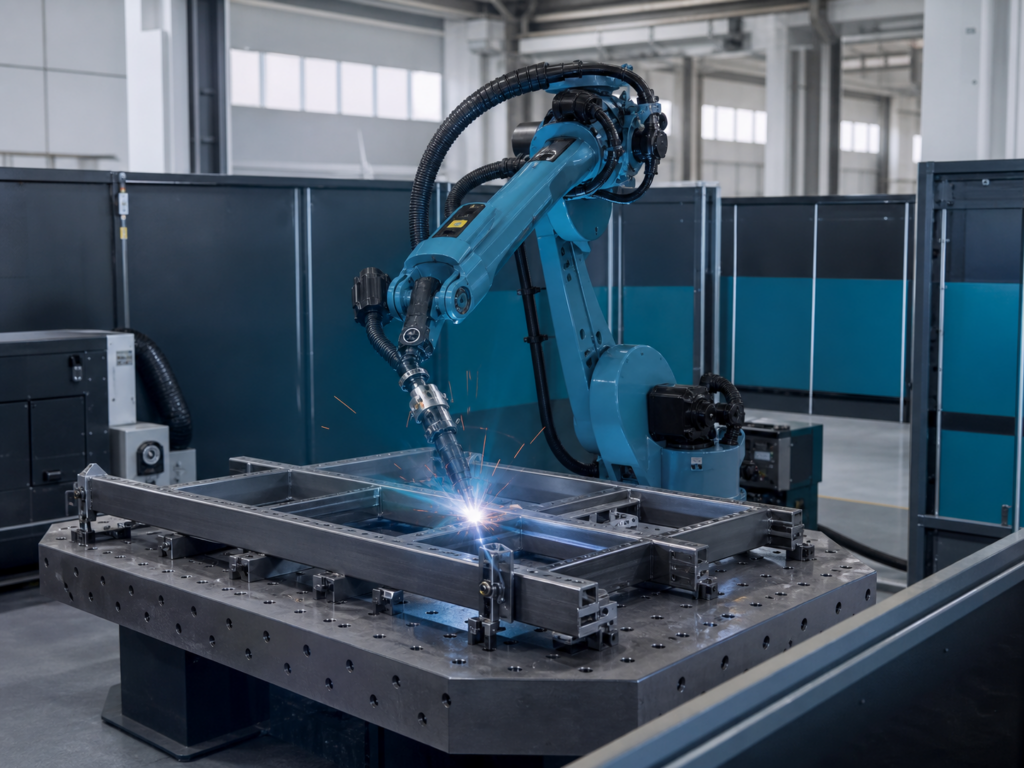
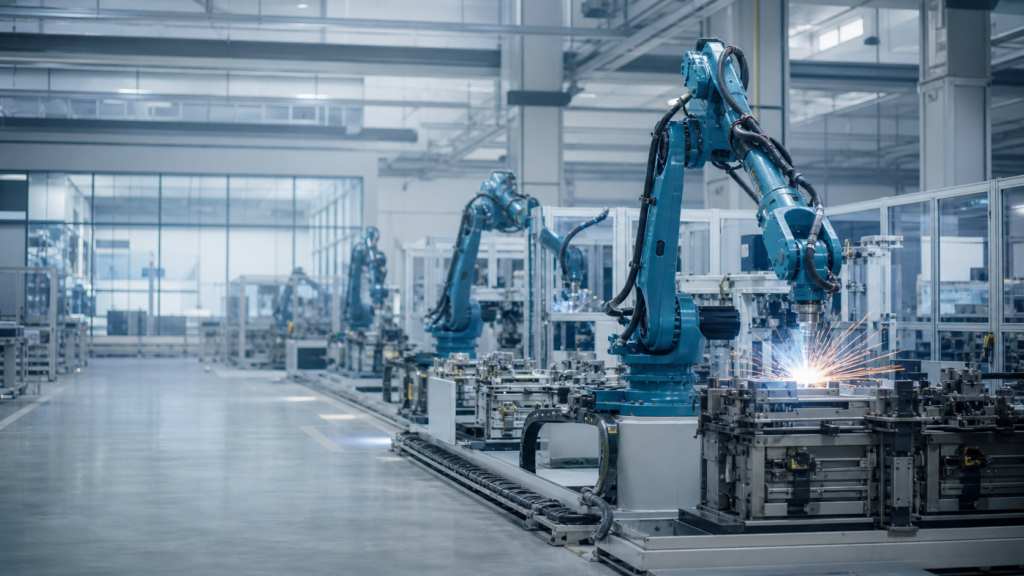
In the wave of transformation and upgrading of modern manufacturing, welding robots, as the core equipment of industrial automation, are completely changing the traditional welding production model. From precision spot welding in automobile manufacturing to heavy arc welding in engineering machinery, from laser welding in aerospace to large structural welding in shipbuilding, industrial welding robots have become standard equipment for intelligent upgrading of manufacturing industry with their advantages of high precision, high efficiency and high stability.
As China’s manufacturing industry moves toward high-end, the intelligent welding robot market is experiencing explosive growth. Data shows that China’s welding robot sales exceeded 63,000 units in 2025, with market penetration exceeding 12% for the first time, and is expected to maintain a compound annual growth rate of over 25% from 2026 to 2035. Against the background of rising labor costs and shortage of skilled welders, automatic welding robots not only solve the employment problem but also realize standardization of welding quality and digital management of production processes. - Main Types and Technical Characteristics of Welding Robots
2.1 Arc Welding Robots: The Most Widely Used Welding Solution
Arc welding robots are currently the most widely used type of welding robots, accounting for approximately 54% of total installations. These robots are mainly used for MIG/MAG/TIG/GMAW and other arc welding processes, and are widely used in automotive parts, engineering machinery, steel structures and other industries. Modern arc welding robots integrate advanced functions such as seam tracking, arc sensing, and multi-layer multi-pass welding, enabling automated welding of complex spatial curves and reducing welding defect rates by more than 50% compared to manual welding.
2.2 Spot Welding Robots: Main Equipment for Automotive Manufacturing
Spot welding robots account for about 38% of the market share, mainly serving the automotive manufacturing industry. A typical car body requires 3,000-5,000 welding spots. Spot welding robots, with ±0.03mm repeat positioning accuracy and operating efficiency of 3-5 spots per second, have become indispensable core equipment in automobile production lines. The new generation of spot welding robots adopts servo welding gun technology, with precisely controllable welding pressure and greatly improved spot quality consistency.
2.3 Laser Welding Robots: Precision Choice for High-End Manufacturing
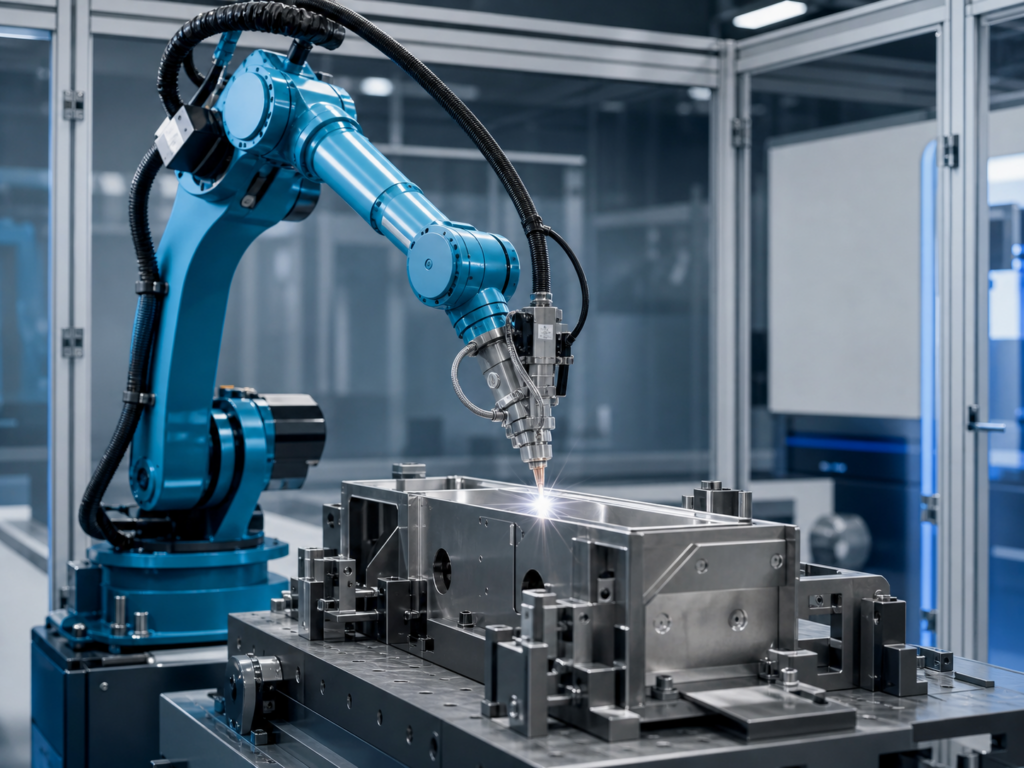
Laser welding robots, as representatives of high-end welding technology, account for about 11% of the market and are growing rapidly. Combining high-power laser sources with high-precision robot arms, these robots can achieve precision welding of ultra-thin materials, dissimilar metals, and complex structures, and are widely used in high-precision fields such as new energy vehicle batteries, aerospace components, and electronic components. Laser welding robots feature small heat-affected zones, minimal welding deformation, and beautiful weld seams, making them key technology for lightweight manufacturing.
2.4 Collaborative Welding Robots: Flexible Choice for SMEs
With the maturity of collaborative robot technology, collaborative welding robots (cobot welding) have become a new choice for small and medium-sized enterprises. These robots require no safety fencing, can work alongside workers, feature flexible deployment and simple programming, and are particularly suitable for flexible production scenarios with high-mix, low-volume production. Collaborative welding robots cost only 50%-70% of traditional industrial welding robots, with significantly shortened payback periods, making them an ideal entry point for automation upgrading in small and medium-sized manufacturing enterprises. - Core Technical Parameters and Selection Guide for Welding Robots
3.1 Interpretation of Key Technical Parameters
When selecting welding robots, the following core parameters directly determine equipment performance:
Repeat Positioning Accuracy: ±0.03mm is the industry benchmark, but attention should be paid to accuracy retention under actual working conditions—accuracy attenuation after high temperature, vibration, and long-term operation is more important
Payload Capacity: Welding robots usually require 6-20kg payload, with weight margin reserved for welding torches, sensors, and cables
Working Radius: Selected according to workpiece size, common range is 1400mm-2200mm
Axis Count: 6-axis robots are standard configuration; 7-axis redundant degree-of-freedom robots are suitable for complex spatial welding
Protection Rating: IP65 or above protection required for welding environments to prevent welding spatter and dust intrusion
3.2 Selection Strategy by Application Scenario
Automotive and Component Manufacturing: Prioritize spot welding robots or high-speed arc welding robots, focusing on cycle efficiency and stability
Engineering Machinery/Heavy Equipment: Select high-payload, long-reach arc welding robots with multi-layer multi-pass welding function
New Energy/3C Electronics: Choose laser welding robots or high-precision small welding robots
SMEs/High-Mix Production: Recommend collaborative welding robots or mobile welding workstations
3.3 Welding Robot Price and ROI Analysis
Welding robot prices vary widely and should be comprehensively evaluated based on configuration:
Entry-level domestic welding workstations: $20,000-$45,000
Mid-range imported brand welding cells: $45,000-$85,000
High-end intelligent welding systems: $85,000-$210,000
Investment payback period is typically 12-24 months, with main benefits from:
Labor cost savings: 1 robot replaces 2-3 welders
Production efficiency improvement: Welding speed increased by 30%-100%
Scrap rate reduction: Welding defects reduced by 50%-80%
Extended equipment life: Standardized operation reduces equipment wear - Common Problems and Solutions for Welding Robots
4.1 Welding Deviation Problem
Phenomenon: Weld seam position deviates from expected trajectory
Cause Analysis: TCP calibration error, workpiece positioning deviation, welding torch search failure
Solutions:
Regularly recalibrate welding torch TCP center point
Optimize fixture positioning accuracy
Add touch sensing or vision positioning function
Adjust welding starting point search parameters
4.2 Porosity Defect Resolution
Phenomenon: Porosity appears inside or on weld surface
Cause Analysis: Impure shielding gas, workpiece oil contamination/rust, improper gas flow
Solutions:
Replace high-purity shielding gas (99.99% or above)
Thoroughly clean oil and oxide scale on workpiece surface before welding
Optimize gas flow (usually 15-25L/min)
Check gas circuit for leaks
4.3 Excessive Spatter Control
Phenomenon: Large amount of metal spatter generated during welding
Cause Analysis: Mismatched welding parameters, improper torch distance, wire quality issues
Solutions:
Optimize welding current, voltage, and welding speed ratio
Maintain 10-15mm distance between torch and workpiece
Use high-quality copper-plated welding wire
Adopt pulse welding process to reduce spatter
4.4 Undercut Defect Prevention
Phenomenon: Concave grooves appear at weld edges
Cause Analysis: Excessive welding current, improper torch angle, excessive welding speed
Solutions:
Appropriately reduce welding current
Adjust torch angle to 15-30 degrees
Optimize welding speed and oscillation parameters
Use seam tracking for real-time correction - Welding Robot Maintenance and Service Life Extension
5.1 Daily Maintenance Points
Daily Inspection:
Clean spatter from welding torch nozzle
Check shielding gas circuit pressure and flow
Confirm smooth wire feeding
Clean dust from robot body surface
Weekly Maintenance:
Check lubricant level of each axis
Tighten connecting bolts
Calibrate TCP center point
Clean dust filter device
Monthly Maintenance:
Lubricate each axis lubrication points
Check cable wear condition
Backup robot program parameters
Comprehensive safety function test
5.2 Wearing Parts Replacement Cycle
Contact Tip: Replace every 50-100 hours
Nozzle: Replace every 200-300 hours
Diffuser: Replace every 500-800 hours
Wire Feed Roller: Replace every 1000-1500 hours
Robot Battery: Replace every 2-3 years - Industry Development Trends and Future Outlook for Welding Robots
6.1 AI and Large Models Empowering Intelligent Welding
Artificial intelligence is reshaping welding robot technology. China’s first industrial-grade welding large model has realized intelligent Welding Procedure Specification (WPS) generation, real-time welding quality prediction, and automatic fault diagnosis, reducing traditional welding process development cycle by 60%. In the future, AI welding robots will have autonomous learning capabilities, able to automatically optimize welding parameters according to workpiece material and thickness, truly realizing “one-click welding”.
6.2 Popularization of Machine Vision and Seam Tracking Technology
Vision guidance has become standard for high-end welding robots. 3D laser vision systems can identify weld position in real-time, measure groove dimensions, and dynamically correct welding trajectory, ensuring welding quality even with workpiece assembly deviations. With declining vision sensor costs, vision welding robots will rapidly penetrate from high-end markets to general markets.
6.3 Digitalization and Industrial Internet Integration
Welding robots are no longer isolated production equipment but important nodes in intelligent manufacturing systems. Through industrial internet platforms, enterprises can realize centralized monitoring, data collection, and remote diagnosis of multiple welding robots, with every parameter in the welding process traceable, providing data support for quality control and process optimization. - Conclusion: Choose the Right Welding Robot, Start a New Journey of Intelligent Manufacturing
Welding robots, as landmark equipment in the Industry 4.0 era, have surpassed simple “machine replacement” and become the core 抓手 for realizing manufacturing upgrading, quality improvement, and cost optimization. Whether it’s intelligent production line construction for large enterprises or automation transformation for SMEs, selecting the appropriate welding robot will be a key step in enhancing enterprise competitiveness.
When choosing welding robot manufacturers, it is recommended to comprehensively consider technical strength, service network, case experience, training support and other factors, prioritizing system integrators that can provide complete welding solutions rather than pure equipment suppliers. Only by deeply integrating robot technology with welding processes can the maximum value of automated welding be truly realized.
Recommended Products